Henry Pelham
All the Old KnivesHenry Pelham is an intelligence officer whose pursuit of a leak is inseparable from the past he shares with Celia Favreau. In the California meeting that frames his return to her, he travels with a phone meant to record their conversation and an investigation he insists must continue; by the end, his wish for evidence has given way to a wish for justification, and Treble is waiting outside to act against Celia. Henry’s divided motives make him both investigator and subject of the story’s inquiry into betrayal, institutional self-preservation, and the stories people tell themselves to make their choices bearable.
Identity and Background
Henry works at the United States Embassy in Vienna and has spent years traveling for intelligence work. A flight to California finds him exhausted after fifteen hours in the air and six thousand miles of travel. His fatigue is not ordinary weariness alone: he traces his inability to sleep on planes to 2006, when he was thirty-nine, and to the Flughafen. After watching high-definition footage of 120 bodies aboard an airplane, he can no longer relax in coach. The number and image remain present in the routine of travel, turning a familiar professional circumstance into a reminder of mass death.
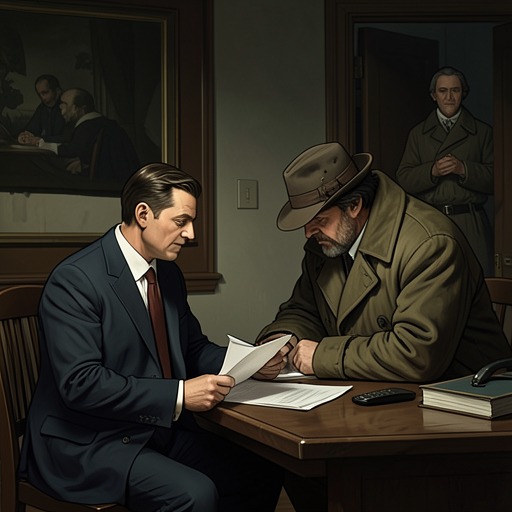
A September 28, 2012, email header identifies Henry as the sender and Celia as the recipient, placing their correspondence within the period of his return. In California, he keeps his phone locked away during the journey and tries to treat the meeting as a manageable professional appointment. If Celia is not at the restaurant, he imagines ordering a dry martini and fried shellfish, considering civilization’s collapse, returning to the airport, and flying back to San Francisco. The carefully rehearsed alternative reveals how effortfully he tries to make the visit seem inconsequential: he anticipates not only disappointment but the relief of not having to look Celia in the eyes.
The Investigation and Its Institutional Stakes
Henry refuses to bury an investigation into Frankler, although he dislikes the prospect of Larry Daniels taking it over. He sees Daniels as unpleasant but capable, and fears that shelving the matter would only allow Daniels to revive it, make a public disturbance, and remove the inquiry from Henry’s control. More immediately, Henry argues that failing to speak with Celia would leave a conspicuous gap in the investigation. Victor Wallinger urges him to finish quickly, especially with the next day bringing further problems, but Henry continues toward the meeting while wondering whether Celia expects an official discussion, a reunion, or something more intimate.
Celia later describes the chain of events that brought her back into intelligence work. After moving to California, she had hoped for relaxation, some luxury, intellectual stimulation, a safe place to raise her children, and, above all, escape from the Central Intelligence Agency. About two weeks after arriving, however, she received a call from Karl Stein, who told her that Bill Compton was selling secrets to Islamist groups, including the Taliban and al Qaeda. Karl asked her to help draw Bill to Vienna and entrap him, invoking the Flughafen and the need to give the Austrians answers. Celia’s account makes the investigation’s personal cost explicit: the suspected traitor was someone she called her Bill, a colleague to whom she had devoted a substantial part of her life. Henry’s own determination to keep the inquiry in his hands thus unfolds within a system that turns old attachments into operational instruments.
Celia, Shishani, and the Recorded Conversation
Henry’s meeting with Celia is also a confrontation with his own uncertainty about their former relationship. As she speaks, he attends to her voice, scent, and occasional touch, and privately wonders whether he still loves her. He has long carried an image of her that he cannot confidently distinguish from the person before him. The possibility that his remembered Celia was partly his own construction unsettles both his sense of the past and his understanding of what their love meant. He does not admit these questions to her; instead, they remain entangled with the phone in his pocket, which is recording their words for the job.
The conversation also revisits Henry’s connection to Ilyas Shishani. Celia says she had expected Henry, given his background with Shishani, to be the one who tracked him down, rather than soldiers in Afghanistan. She wonders, without claiming to know, whether Shishani chose Vienna because Henry worked at the embassy: perhaps to provoke him, seek his help, or surrender to him. Her speculation makes Henry’s professional past part of the emotional and interpretive uncertainty between them. The significance of Vienna may be operational, personal, or both, but Celia cannot settle which explanation is true.
A transcript later labels the conversation as a Federal Bureau of Investigation record: it was taken from a cell-phone flash card removed from Karl Stein’s premises on November 7, 2012, as part of an investigation into Karl’s actions on October 16. In the recorded exchange, Henry raises Ahmed’s last message and Celia explains how she detected that one of four messages differed in grammar from the others. She noticed the change while Bill Compton was away with Sally Compton, laid the four messages side by side, and recognized that a different person had written one. The transcript preserves both the practical method of her deduction and the circumstances in which she made it, while establishing that Henry’s conversation with her became evidence in a later investigation.
Accusation, Admission, and Agency Logic
Henry eventually demands that Celia acknowledge having called Ilyas Shishani and told him about Ahmed, accusing her of destroying the only chance to get the people aboard Flight 127 out alive. Celia responds by asking whether she did. Her tears are gone; she hardens in front of him. Henry’s question is not simply an effort to establish a fact. Before Treble leaves the restaurant, Henry has already decided that Celia will soon be unable to defend herself, and he wants a final answer he can use if Victor Wallinger or someone at Langley traces what he has done. He frames the dilemma as an institutional one: suspected traitors cannot be let off the hook, but they cannot be prosecuted either. He presents his own coming action as the inevitable conclusion of Central Intelligence Agency logic.
At half past nine, after two and a half hours in the restaurant, Henry checks the regular cell phone and realizes that the other phone—the one recording the conversation—has stopped. He decides that the recording no longer matters and tells Celia that he did it for her. When she flinches, he makes the personal grievance explicit: he blames her for walking out on him after everything that happened on the plane. His admission does not resolve the accusation he has just made against her. Instead, it reveals that his choices, too, are bound to the events aboard Flight 127 and to the abandonment he believes followed them. Evidence, confession, and love have become difficult for him to separate.
Treble and the Ending
Treble has been present as a businessman who rises from his table and passes Celia on his way out. Henry knows who he is and lets him leave. Afterward, Henry remains alone with Celia and continues to seek a final justification for what he has decided. The scene’s ordinary gestures—a departing diner, a phone checked for the time, a recording that has gone silent—sit beside the threat of an assassination Henry has arranged. The contrast exposes how calmly he tries to make violence fit the language of procedure.
Later, Treble calls to report that he has Celia in front of him as she walks slowly down the street, apparently crying. Henry confirms his identity, but the answer comes from a man who is unsure who he is and trying to listen for his own heartbeat. The report establishes that Treble has found Celia; it does not, in this moment, confirm what happens to her afterward. Henry’s ending is therefore poised between the operation he set in motion and the collapse of the professional certainty he used to authorize it.
Narrative Role and Significance
Henry narrates the California encounter in the first person, restricting the reader to what he perceives, remembers, suspects, and admits. That closeness supplies concrete access to his fatigue, physical responses, and divided attention, but it also makes his self-justifications part of the evidence to be weighed. He can explain why he wants the investigation to remain in his hands and invoke institutional rules against Celia, yet his private reflections and eventual admission expose motives that the official argument cannot contain.
The narrative repeatedly places recording beside memory. Henry arrives with a phone recording his words; the later transcript turns that private conversation into an investigative document; then the recording ceases, and he says what he had been holding back. The change does not make his account transparent or settle the truth about Celia’s alleged call. It instead shifts the scene from the pursuit of a usable record to the pursuit of a personal explanation. Henry’s consequential failure is not merely that he mixes love with intelligence work, but that he treats his own injury as a warrant for an irreversible act while still demanding a confession from someone else.